
Wakulla County Court Records After a Jail Arrest
After an arrest in Wakulla County, the path to a court record runs through several offices. The Sheriff books the person at the detention facility. A judge holds a first appearance to address bond and probable cause. Then the State Attorney for the Second Judicial Circuit reviews the case and decides what to file. The charges the prosecutor files become the court record, and the Wakulla County Clerk of Court maintains the case from there. So the arrest and the court record are linked but separate, and they can carry different charges.
The booking side and the court side answer different questions. For who is in custody and what the booking shows, the jail inmate records page covers the roster and records-request channels, and the jail mugshots page covers booking photos. This page stays on the court record itself, the charges a prosecutor filed after the arrest and how to follow them as the case moves.
How to Find Wakulla County Court Records After an Arrest
The court case search is run by the Clerk of Court, not the Sheriff. The Clerk links its court records search to the CiviTek portal, which opens with access options before any name box. Public access is anonymous, while attorney, registered, and party access need credentials.
The access screen for that portal is shown below so the right starting point is clear.
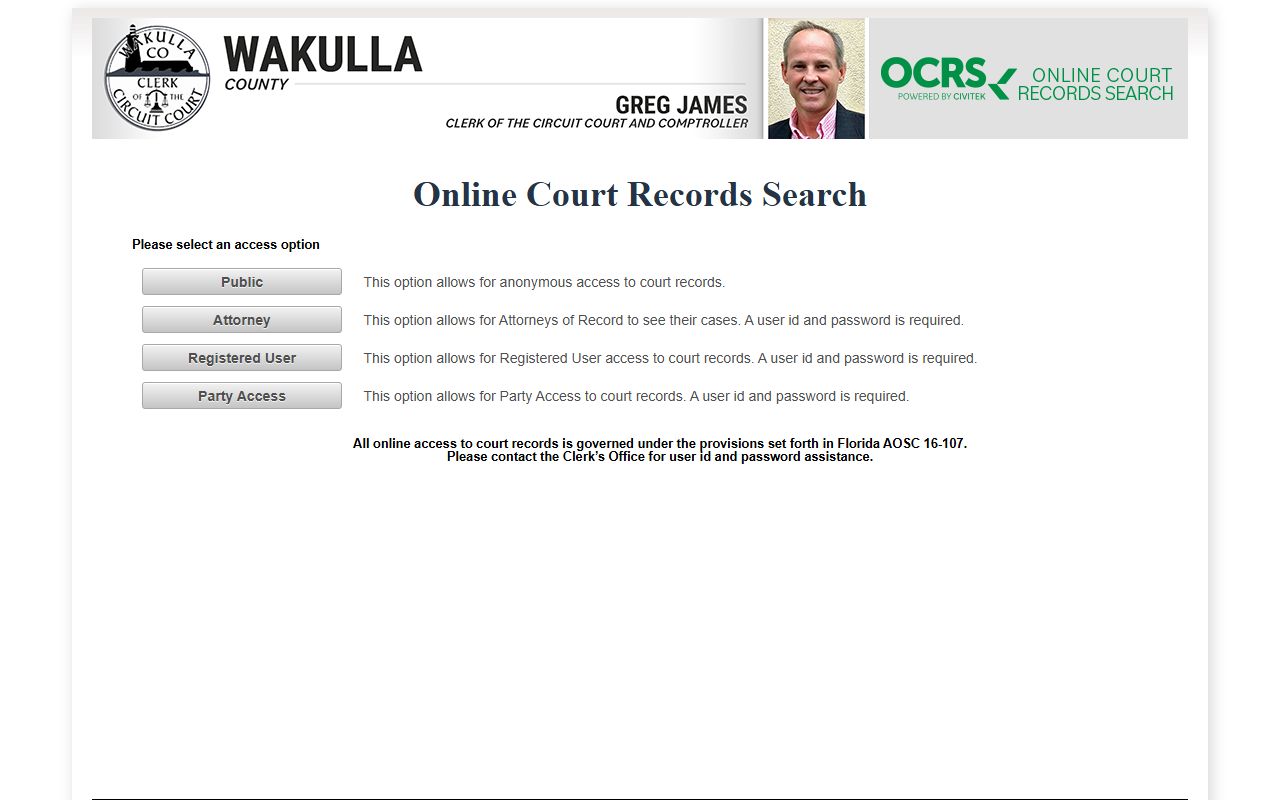
Open the Wakulla Online Court Records Search and choose Public, then follow these steps.
- Select Public for anonymous access to the case index.
- Search by the defendant's name or by a case number.
- Open the case and read the list of filed charges.
- Check each charge's level and current status in the docket.
Online access is governed by Florida AOSC 16-107, and some records are not posted. Under Rule of Judicial Administration 2.420(f)(1), a request for those must be in writing to the records custodian and specific enough to identify the case.
How Charges Get Filed After an Arrest: Complaint, Information, and Indictment
The arrest does not set the final charges. After booking, the charge record begins when a charging document is filed. In Florida, most felony cases proceed on an information filed by the State Attorney, while the most serious cases can go to a grand jury for an indictment. The table sorts the three common types.
| Complaint | Information | Indictment | |
|---|---|---|---|
| Filed By | Officer or prosecutor | State Attorney | Grand jury |
| Common For | Misdemeanors | Many felonies | Serious felonies |
| Starts | The case | The case | The case |
The Wakulla Clerk groups felony cases by class, from capital and life felonies down to third degree, each with its own punishment cap. That class affects which court division holds the file and how the case is handled.
Charge Status and What It Means
Charges shift as a case moves. A prosecutor may amend, reduce, add, or drop a charge after reviewing the evidence, which is why the booking charges on a jail record can differ from the charges the court finally lists. The status terms below appear in Wakulla County dockets.
| Status | What It Means |
|---|---|
| Pending | A filed charge that has not yet been resolved. |
| Amended or Reduced | A charge changed or lowered, often through a filing or plea. |
| Dismissed | A charge ended by action of the court or the prosecutor. |
| Nolle Prosequi | The prosecutor has chosen not to pursue the charge. |
Note: a set felony court date cannot be changed by the Clerk, so contact the attorney of record if a scheduled date is a problem.
Who Files the Charges in Wakulla County
Florida calls its chief prosecutor a State Attorney rather than a District Attorney. Wakulla County falls in the Second Judicial Circuit, led by State Attorney Jack Campbell, whose office also covers Leon, Franklin, Gadsden, Jefferson, and Liberty counties. This office decides whether to file charges after an arrest, what to file, and whether to amend or drop them later.
The office homepage links case information for Wakulla through the same CiviTek search.
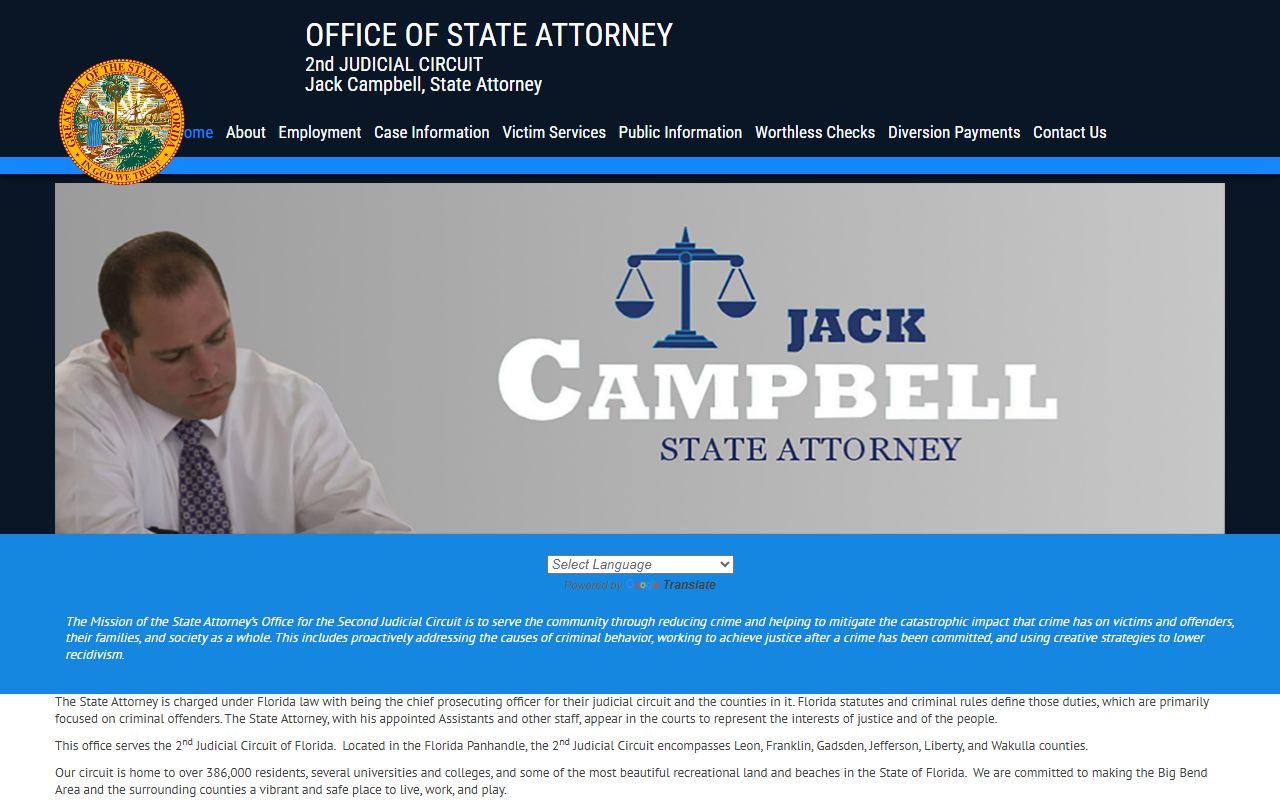
The State Attorney's office lists a Wakulla line at 850-926-0914 for prosecution questions, while filed case status still comes from the Clerk.
Bond and Release After an Arrest
Bond is normally set by a judge at first appearance. In Wakulla County, the Sheriff lists two ways to bond someone out of the detention center: hire a bonding agency, or bring a cashier's check or money order for the full bond amount to the detention center lobby, made payable to the Wakulla County Sheriff's Office. An inmate with enough money in commissary can also post bond directly. The Sheriff stresses calling first to verify the correct amount.
| Bond Type | How It Works |
|---|---|
| Cashier's Check or Money Order | Full bond amount paid at the detention center lobby to WCSO. |
| Surety Bond | A licensed bonding agency posts the bond for a fee. |
| Own Commissary Funds | The inmate posts bond from a sufficient commissary balance. |
| No-Bond Hold | A detainer or other hold blocks release despite a dollar bond. |
Holds matter most here. Because the jail also houses immigration and federal pretrial detainees, an outside detainer can keep a person in custody even when the local charge has a set bond. Verify holds with the Sheriff and the court before paying anything.
Warrants That Lead to an Arrest
An outstanding warrant is a common road into the detention facility. The Sheriff's Office runs no public online active-warrant search, so a warrant is usually confirmed through the court file or by contacting the right office. The Civil Division handles court-issued process under Florida Statute 30.15 and answers at 850-745-7145 during business hours.
The civil and warrant page details that process and its fees.
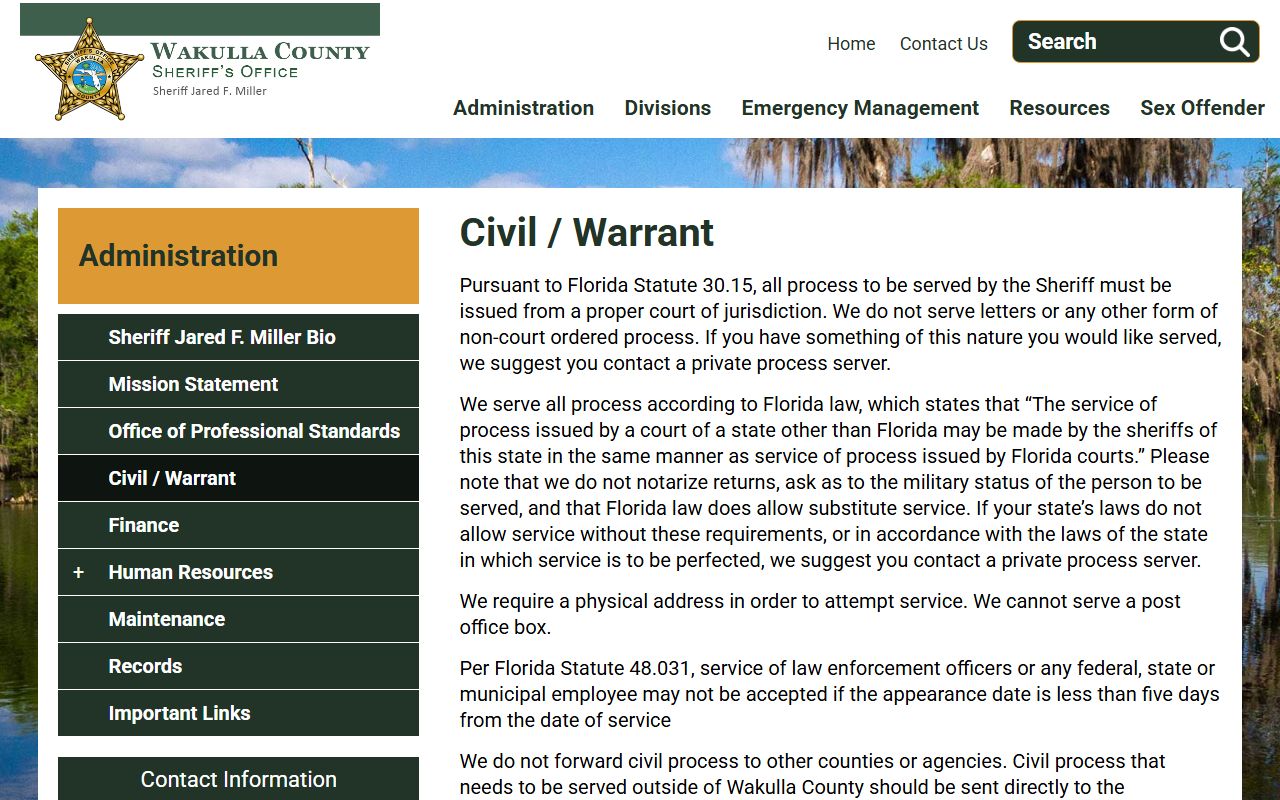
The Civil and Warrant page explains that the Sheriff serves only court-ordered process and requires a physical address. For federal felony warrants, a regional U.S. Marshals task force that includes Wakulla County handles fugitive cases.
Charges vs. Convictions
An arrest and a charge are accusations, not proof of guilt. A conviction comes only after a plea or a verdict. The court record can show both, so read the disposition rather than stopping at the charge.
| Charge | Conviction | |
|---|---|---|
| Stage | Accusation | Verdict or plea |
| Burden of Proof | Probable cause | Beyond a reasonable doubt |
| Public Record | Yes | Yes |
Florida also allows a withheld adjudication in some cases, where a judge withholds a formal conviction despite a plea or finding. That status changes how the record reads and what relief may be available later.
Sealed vs. Expunged Arrest Records
After a dismissal or an eligible disposition, a person may be able to seal or expunge the record. Florida governs sealing under Statute 943.059 and expunction under Statute 943.0585, and not every case qualifies. The Clerk points people to the state process and can explain instructions, while the formal application runs through the state law enforcement seal and expunge program.
| Sealed | Expunged | |
|---|---|---|
| Visibility | Hidden from public view | Destroyed or treated as never existing |
| Law Enforcement | Limited access remains | Very limited access |
| Eligibility | Set by Florida Statute 943.059 | Set by Florida Statute 943.0585 |
Sealing or expunging the court case is also the proper route to address a booking photo tied to that arrest, rather than paying a commercial removal service.
Clerk Copy Fees and Mailed Requests
Copies of Wakulla County court records carry set fees. The Clerk lists copies at $1.00 per page, a search at $2.00 per name or case, and a certified copy at an extra $2.00 per certification. Mailed requests must include payment, a self-addressed stamped envelope, and a prior call to confirm the page count, and processing runs about seven to ten working days.
The felony page also notes that inactive case files may be stored off site and take a day or so to retrieve, so calling first saves a wasted trip.
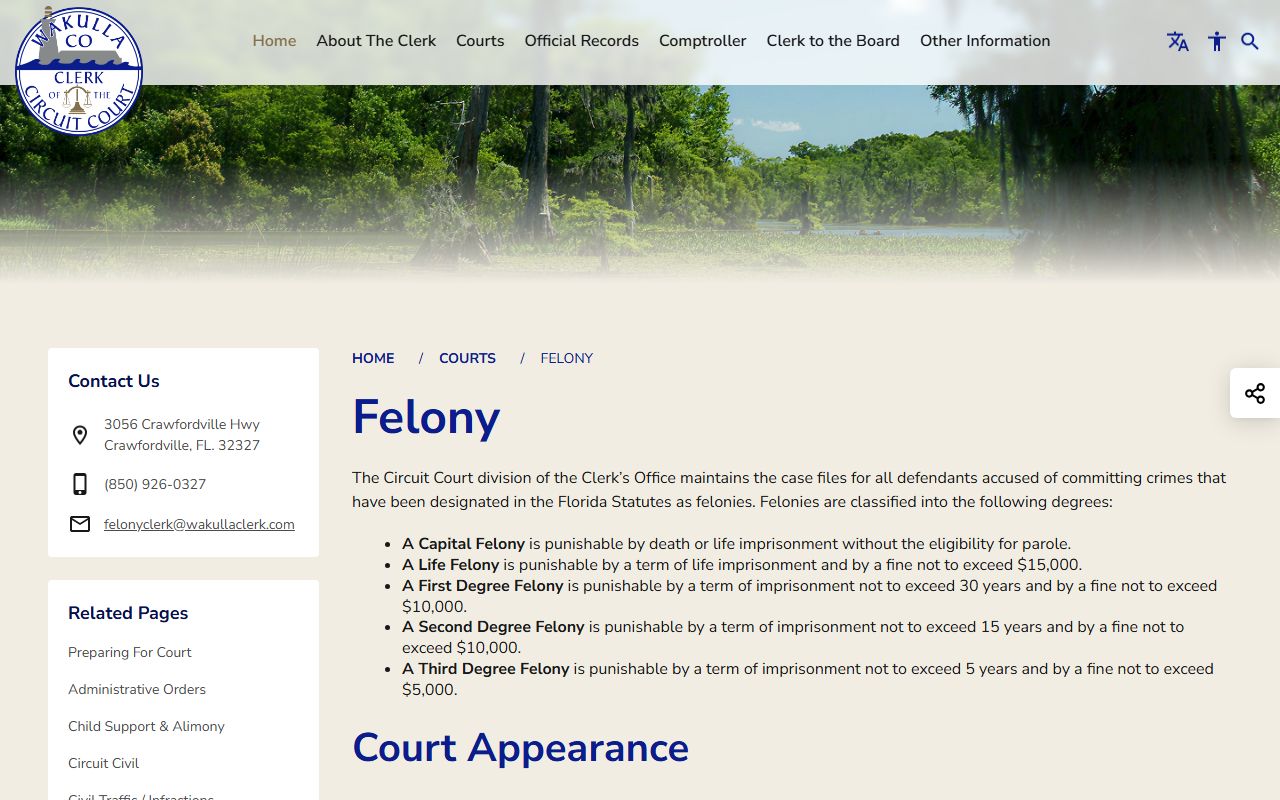
The Clerk felony page lists the fees, the written-request rule, and the mailing address at 3056 Crawfordville Hwy, with a clear instruction not to mail cash.
Important: This is a private reference site and not a consumer reporting agency, so nothing here may be used for FCRA-covered screening such as employment or housing.
Restricted Court Records After an Arrest in Wakulla County
Not every court record after an arrest is open. Juvenile cases, sealed or expunged charges, and records tied to an active investigation may be withheld or redacted under Florida's public records exemptions. Personal identifying information can be removed as well. When the online index shows nothing for a name you expect, a restriction or a simple data delay is often the reason, and a written request to the Clerk is the way to test it.